BLOGS
Ducted vs Ductless AC Installation in Tulsa: Which Fits Your Home?
Tulsa summers can bring intense heat, making a reliable air conditioning system essential for indoor comfort.
If your current AC is aging, your home has uneven temperatures, or you are building or remodeling a house, you may be considering a new cooling system.
Ducted and ductless air conditioning are two popular options. Both do a good job of cooling, but they work differently and are appropriate for different homes. The more you know about the pros and cons of each, the better able you will be to make a confident decision.
In this guide, we will compare ducted vs. ductless AC installation in Tulsa and explain which option may work best for your home.
What Is a Ducted Air Conditioning System?
A ducted AC system uses a central indoor unit and a network of air ducts to distribute cooled air throughout the home. The system typically connects to vents located in different rooms.
This setup is common in homes with existing ductwork. A properly designed ducted system can provide consistent whole-home cooling from a single central unit.
For homeowners who want a single cooling solution for multiple rooms, ducted air conditioning can be a practical choice.
Benefits of Ducted AC
A ducted system offers several advantages:
- Whole-Home Cooling: One system can cool multiple rooms simultaneously.
- Clean Appearance: Most of the equipment remains out of sight, with only vents visible inside.
- Consistent Temperature Control: A properly sized system can provide balanced airflow throughout the home.
- Centralized Operation: Homeowners can control the system with a single thermostat.
- Good Fit for Existing Ductwork: If your home already has suitable ducts, installation may be more straightforward.
What Is a Ductless AC System?
A ductless AC system, often called a mini-split system, does not require traditional air ducts. Instead, it uses an outdoor unit connected to one or more indoor air-handling units.
Each indoor unit is installed directly in the room or area it serves. This allows homeowners to cool specific spaces without installing or extending a duct network.
Ductless systems can be especially useful for older homes, additions, converted garages, or rooms that are difficult to connect to existing ductwork, and a
licensed hvac installer can help determine whether this setup is appropriate for your space.
Ducted vs Ductless AC: What Is the Difference?
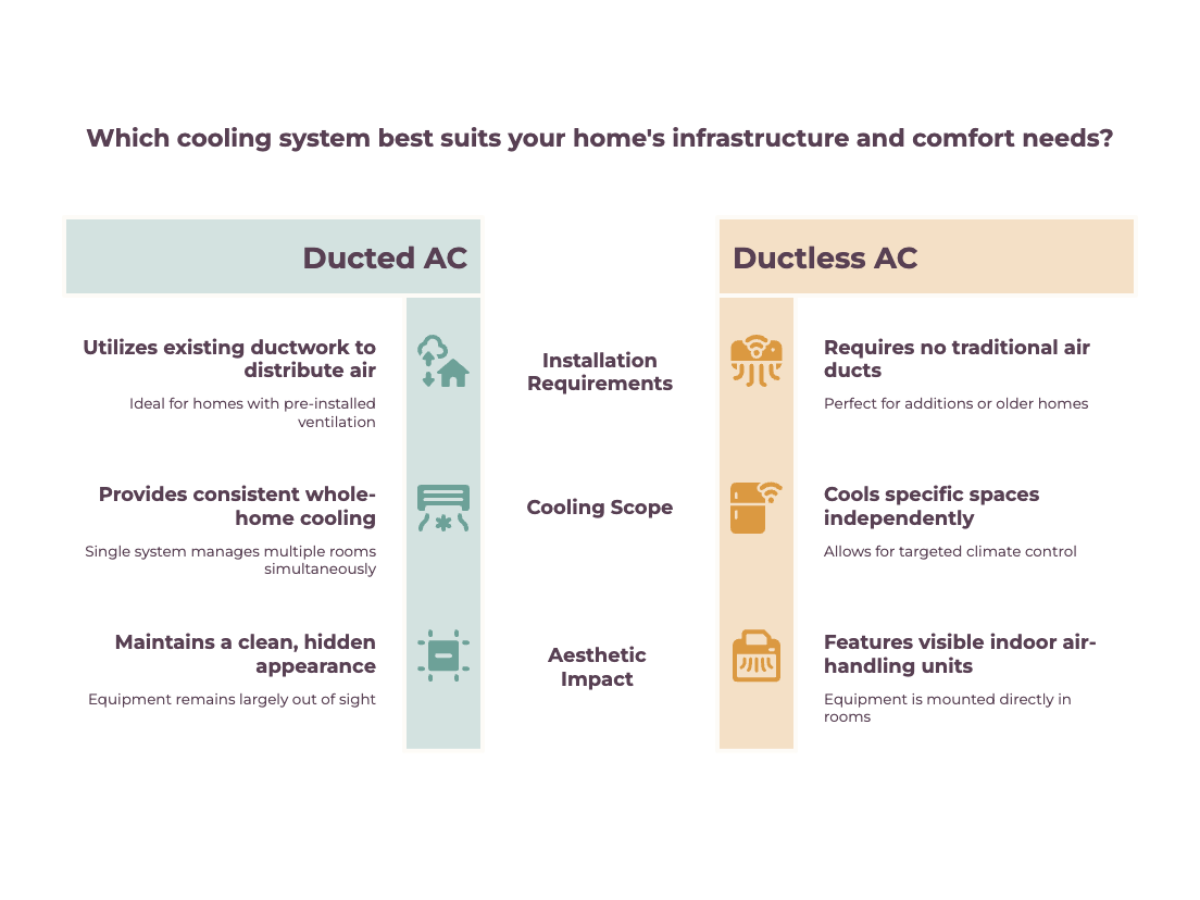
The main difference is how cooled air reaches each room.
A ducted system distributes air through a central network of ducts. A ductless system delivers conditioned air directly into individual rooms or zones.
With ducted vs. ductless AC installation in Tulsa, the right choice depends less on which system is universally better and more on your home's layout, existing HVAC setup, comfort needs, and budget.
Installation Requirements
Ducted systems require properly designed and installed ductwork. If your home already has usable ducts, the installation process may be simpler. If new ductwork is needed, the project can become more extensive.
Ductless systems do not require traditional duct installation. This can make them a useful option for homes where adding ducts would involve significant remodeling.
Energy Efficiency
Both systems can offer efficient cooling when correctly sized and installed.
Ductless systems may reduce energy losses associated with leaky or poorly insulated ductwork because conditioned air does not travel through ducts.
Ducted systems can still provide excellent efficiency when the ductwork is properly designed, sealed, and insulated.
Temperature Control
Ductless systems offer zoned comfort. You can adjust the temperature in individual rooms or areas based on their use.
A traditional ducted system generally provides centralized temperature control. Some modern ducted systems can also incorporate zoning, allowing different areas of the home to have separate temperature settings.
Appearance and Space
Ducted systems have an advantage when homeowners prefer a less visible indoor setup. Most components are hidden, while vents blend into ceilings, walls, or floors.
Ductless systems require indoor units to be mounted within the rooms they serve. Although modern units have a relatively compact design, they remain visible.
Which AC System Is Better for Tulsa Homes?
There is no single answer for every Tulsa homeowner. The best system depends on your property.
A ducted AC system may be a better fit if:
- Your home already has functional ductwork.
- You want centralized whole-home cooling.
- You prefer most HVAC equipment to remain hidden.
- You are replacing an existing central AC system.
- You are building a new home with space for planned ductwork.
A ductless system may be a better fit if:
- Your home does not have existing ductwork.
- You want to cool specific rooms or zones.
- You have an addition or converted space without duct access.
- You want more individual temperature control.
- Installing new ductwork would require major remodeling.
Why Choose Air Masters Inc. for AC Installation in Tulsa?
Whether you need a new central AC system, ductless cooling, or another HVAC solution, Air Masters Inc. can help you understand your options and select a system that fits your home's comfort needs.
For professional AC installation in Tulsa, contact Air Masters Inc. to discuss your home's cooling needs.
Frequently Asked Questions
Is ducted or ductless AC better for a Tulsa home?
Neither option is best for every home. Ducted AC can work well for whole-home cooling, while ductless systems can be useful for homes without ductwork or for targeted cooling.
Is ductless AC more energy efficient than ducted AC?
It can be, particularly when zoning allows you to cool only occupied areas. However, a properly designed and maintained ducted system can also operate efficiently.
Can ductless AC cool an entire house?
Yes. You can link multiple indoor units to a single outdoor unit to create different cooling zones around the house. The setup depends on the size and layout of the house.
Is ducted AC harder to install?
That depends on the property. If you don't have ductwork, you may need more work to convert to a ducted system. Existing usable ductwork can make the process easier.