BLOGS
Office Building HVAC Design: Creating Optimal Comfort for Employee Productivity
Walk into any office on a sweltering Tulsa afternoon, and you can tell within seconds whether the HVAC system is doing its job. Stuffy air, uneven temperatures, that one corner desk that feels like a freezer, while the conference room turns into a sauna. These aren't small annoyances. They quietly chip away at focus, mood, and the bottom line.
At Air Masters Inc., we've spent years designing commercial HVAC systems for office buildings across Oklahoma, and we've seen firsthand how the right setup transforms a workplace. Let's break down what good office HVAC design looks like and why it matters more than most business owners realize.
Why Office HVAC Design Directly Impacts Productivity
Temperature isn't just about comfort. It's about cognitive performance. Studies from Cornell University and the Helsinki University of Technology have shown that office workers who keep their temperatures between 70°F and 73°F make significantly fewer typing errors and stay sharper throughout the day.
When the indoor climate swings too hot or too cold, people stop thinking about their work and start thinking about their thermostat. Headaches creep in, drowsiness sets in after lunch, and meetings drag. A well-designed office building HVAC system keeps the air consistent and fresh, working quietly in the background so your team can do the same.
Beyond temperature, indoor air quality plays a huge role. Poor ventilation traps CO2, dust, allergens, and volatile organic compounds inside the building. The result? Brain fog, more sick days, and lower morale. Good HVAC design solves all of this at once.
Key Elements of a Smart Office HVAC Design
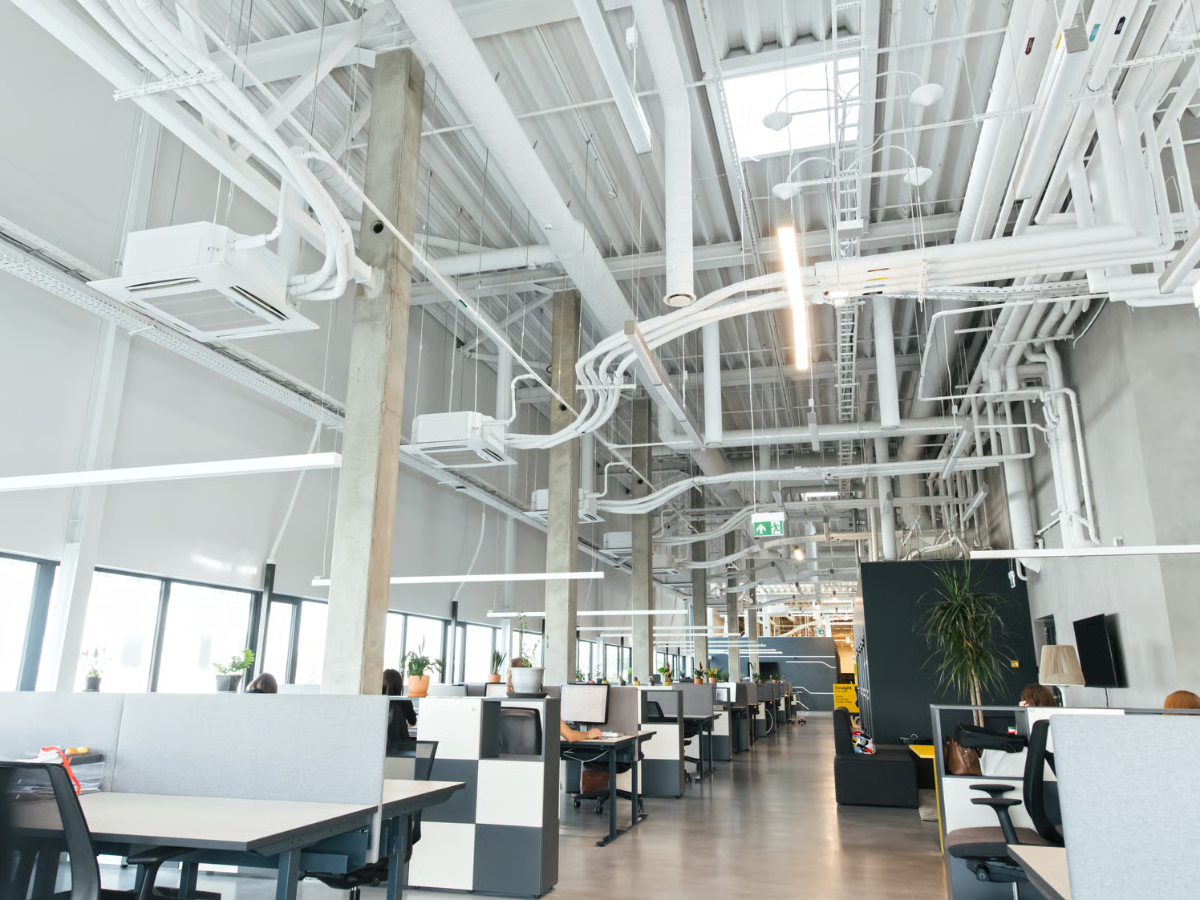
Designing a system for a commercial space is nothing like sizing one for a home. Offices have multiple zones, varying occupancy levels, large open floors, glass walls, server rooms, and break areas, each with its own demands. Here's what we focus on when planning an HVAC layout for any office building in Tulsa.
- Accurate Load Calculation: We start with a Manual N load calculation, which is the commercial-grade equivalent of residential load sizing. These factors include square footage, ceiling height, window orientation, insulation, the number of occupants, and the heat output from computers and lighting. Skipping this step is how buildings end up with oversized units that short-cycle or undersized units that never catch up.
- Zoning for Different Areas: A conference room packed with twelve people generates very different cooling needs than a quiet accounting office. Zoning systems with separate thermostats and dampers let each area maintain its own temperature without overworking the entire system. This is one of the fastest ways to fix the classic "too hot here, too cold there" problem.
- Proper Ductwork Layout: Even the best AC unit can't save a building with bad ductwork design. Leaky ducts, sharp bends, and poorly placed registers cause uneven airflow and waste up to 30% of conditioned air before it reaches the room. Our team designs duct runs that minimize pressure drops and deliver air exactly where people sit and work.
- Ventilation and Fresh Air Intake: ASHRAE Standard 62.1 sets the benchmark for commercial ventilation rates, and we design every system to meet or exceed it. Bringing in filtered outdoor air dilutes indoor pollutants and keeps CO2 levels in check. For larger offices, we often recommend energy recovery ventilators (ERVs) that pre-condition incoming air using the energy from outgoing air, cutting utility costs without sacrificing air quality.
- Humidity Control: Oklahoma summers are humid, and that moisture sneaks into office buildings every time a door opens. A relative humidity between 30% and 60% is the sweet spot for comfort, productivity, and the protection of electronics and furniture. We integrate dehumidification into the design rather than treating it as an afterthought.
Energy Efficiency and Long-Term Savings
A smart HVAC system design isn't just about comfort today. It's about controlling operating costs for the next 15 to 20 years. Variable refrigerant flow (VRF) systems, high-efficiency rooftop units, and smart thermostats with occupancy sensors can dramatically cut energy bills.
Programmable controls let the system ease off at night and on weekends when the building is empty. Pair that with regular preventive maintenance, and an office HVAC system can run efficiently for two decades. We always walk clients through the long-term math because the cheapest system up front is rarely the cheapest over its lifespan.
Common Office HVAC Problems We Fix
Even well-built offices run into HVAC issues over time. Some of the most common calls we get in the Tulsa area include hot and cold spots between floors, strange noises from rooftop units, rising energy bills without a clear cause, weak airflow in back offices, and stale or stuffy air despite the system running constantly.
Most of these problems trace back to either poor original design, undersized ductwork, neglected maintenance, or aging equipment that has quietly lost capacity. The good news is that almost every issue has a fix, and often one that's more affordable than business owners expect.
How We Approach Every Office HVAC Project
Every building is different, so cookie-cutter solutions don't cut it. When a Tulsa business owner calls us about an office HVAC project, we start with a walkthrough. We listen to what's working, what isn't, and what the team has complained about. Then we measure, calculate, and design.
We treat your building like our own, and we explain every recommendation in plain language. No upselling, no scare tactics, no hidden fees. Just honest advice from a family-owned team that has been serving Tulsa for years. That's how we've built our reputation, one office at a time.
FAQ
What is the ideal office temperature for productivity?
Most research indicates a range of 70°F to 73°F for peak productivity. Going too far in either direction leads to errors, fatigue, and reduced employee focus.
How often should commercial HVAC systems be serviced?
We recommend professional maintenance at least twice a year, once before summer and once before winter, to keep your system running efficiently and prevent costly breakdowns during peak seasons.
Can poor office HVAC really affect employee health?
Yes, absolutely. Poor ventilation increases CO2 levels and airborne pollutants, which contribute to headaches, fatigue, allergies, and even Sick Building Syndrome.
What size HVAC system does my office building need?
There's no quick answer. The right size depends on square footage, insulation, occupancy, equipment heat load, and window exposure. A professional load calculation is the only reliable way to size it.
How long does a commercial HVAC system typically last?
With proper installation and routine maintenance, a well-designed commercial HVAC system can last 15 to 20 years. Neglected systems often fail in half that time and cost far more to run.
Ready to Upgrade Your Office Comfort?
Your team deserves an office that feels great to walk into every morning, and your business deserves an HVAC system that doesn't drain your budget. Whether you're designing a brand-new commercial space, retrofitting an aging system, or finally fixing those hot and cold zones that have plagued the office for years, we're here to help.
Reach out to Air Masters Inc. today for a no-pressure consultation. Let our family-owned Tulsa team design a smarter, more efficient HVAC system that keeps your employees comfortable, productive, and proud of where they work. Comfort is good business, and we're ready to prove it.